Website information
Website co-creation
How people have helped create and produce our resources, with participation always a choice.
Source document: Version 1 · Last reviewed October 2026
Co-creation and co-production involve people in shaping and developing information or services, drawing on their experience and expertise. People who have used Ēpiónē's individual psychological therapy, supporter and clinical supervision services have helped create and produce this website and the Considering Psychological Therapy guide. Participation is voluntary: no one is expected to contribute because they use our services, represent others with similar experiences or disclose more than they wish.
What people can help shape
- Website information, guides, forms and reasonable-adjustment resources.
- Explanations of what assessment, therapy, supporter work or supervision may ask of somebody.
- Information design, language, navigation, examples and accessibility features.
- Service-evaluation questions or ways of presenting aggregated learning.
How participation works
Participation is voluntary. Before identifiable feedback is used, we explain what is being asked, how the contribution may be used, whether it will be quoted or anonymised, how long identifiable material will be kept and whether recognition or payment applies. Declining to take part does not affect access to therapy or another service.
Whose voice is represented?
One person’s experience is evidence of that person’s experience. We do not present a single contributor as speaking for all clients, neurodivergent people, supporters, supervisees or people with a particular diagnosis. Where themes are reported, we distinguish a repeated pattern from an individual account.
Protecting privacy and professional boundaries
Therapy material is not automatically repurposed as co-creation material. If something arising in therapy could be useful for a separate public resource, that requires a separate and voluntary decision about use. Clinical consent is not treated as consent to publicity, testimonial use, research or service promotion.
Making it easier and safer to take part
We consider whether the format, timing, communication method or relationship could make participation difficult or create pressure to agree. Reasonable adjustments can be used in the co-creation process itself. Where the therapist-client relationship creates a meaningful power imbalance, extra care is taken not to make participation feel expected.
How learning is used
Feedback helps us decide what to change and what to keep. It may also reveal different access needs. We record material changes and why we made them. We take every contribution seriously, including suggestions we cannot adopt because of competing access needs, clinical responsibilities, legal requirements or practical limits.
If you decide to stop taking part
A contributor can stop participating at any point. Before identifiable material is published or irreversibly anonymised, we will consider a request to withdraw its use. Once material has been lawfully published or fully anonymised, withdrawing it retrospectively may be impossible.
When therapists receiving supervision contribute
A supervisee may contribute to co-creation as a supervisee in their own right. Material about the people they work with must not be repurposed for website or co-creation use merely because it was discussed in supervision. Any example drawn from practice must be genuinely anonymised or have a separate lawful and ethical basis for use.
Our gratitude
Read the acknowledgements as text
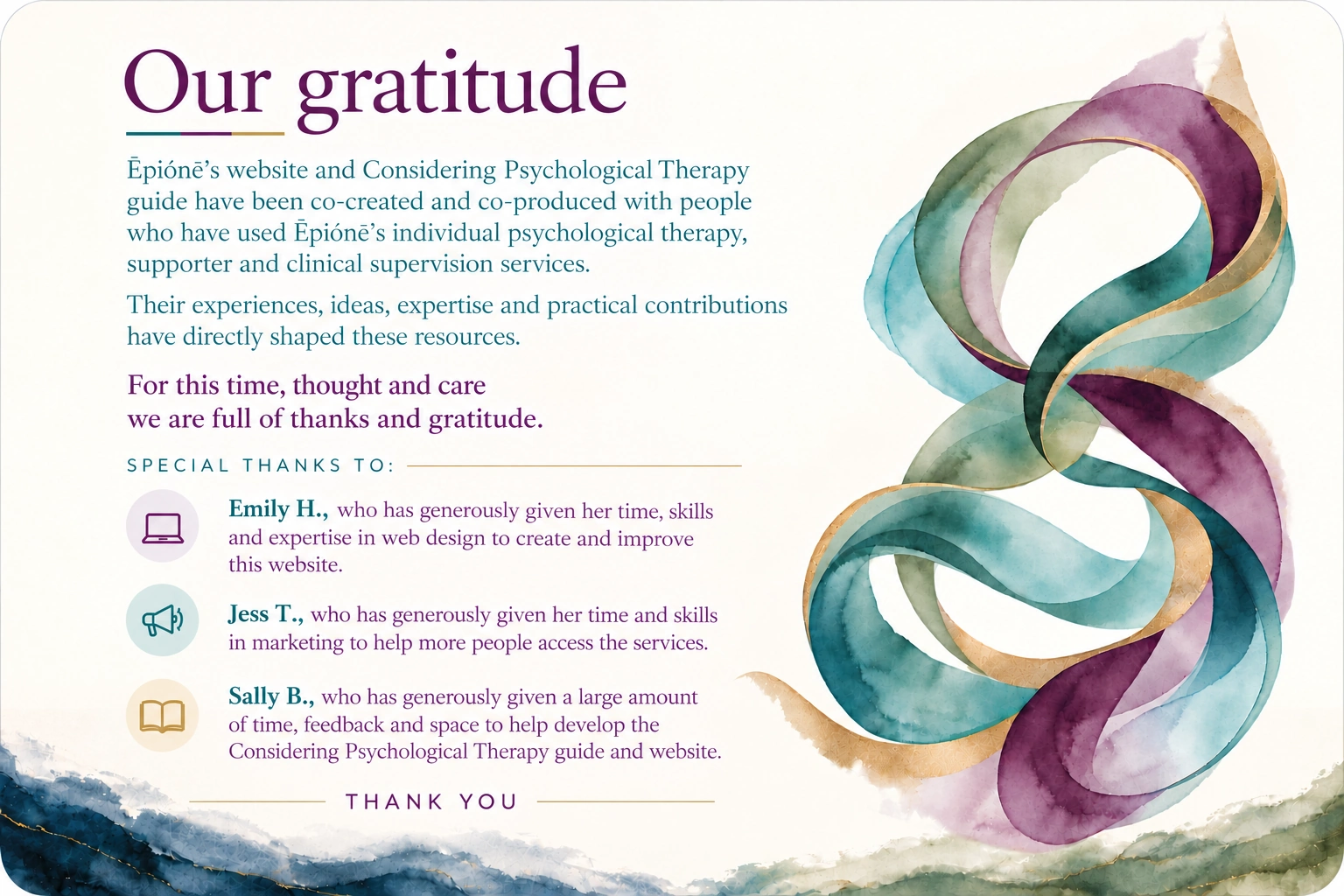
Ēpiónē's website and Considering Psychological Therapy guide have been co-created and co-produced with people who have used our individual psychological therapy, supporter and clinical supervision services. Their expertise and practical contributions have directly shaped these resources. We are grateful for the considerable time and care they have given.
Emily H. has generously given her time and web design expertise to create and improve this website.
Jess T. has generously given her time and marketing skills to help more people access our services.
Sally B. has generously given considerable time, feedback and space to help develop the Considering Psychological Therapy guide and website.